
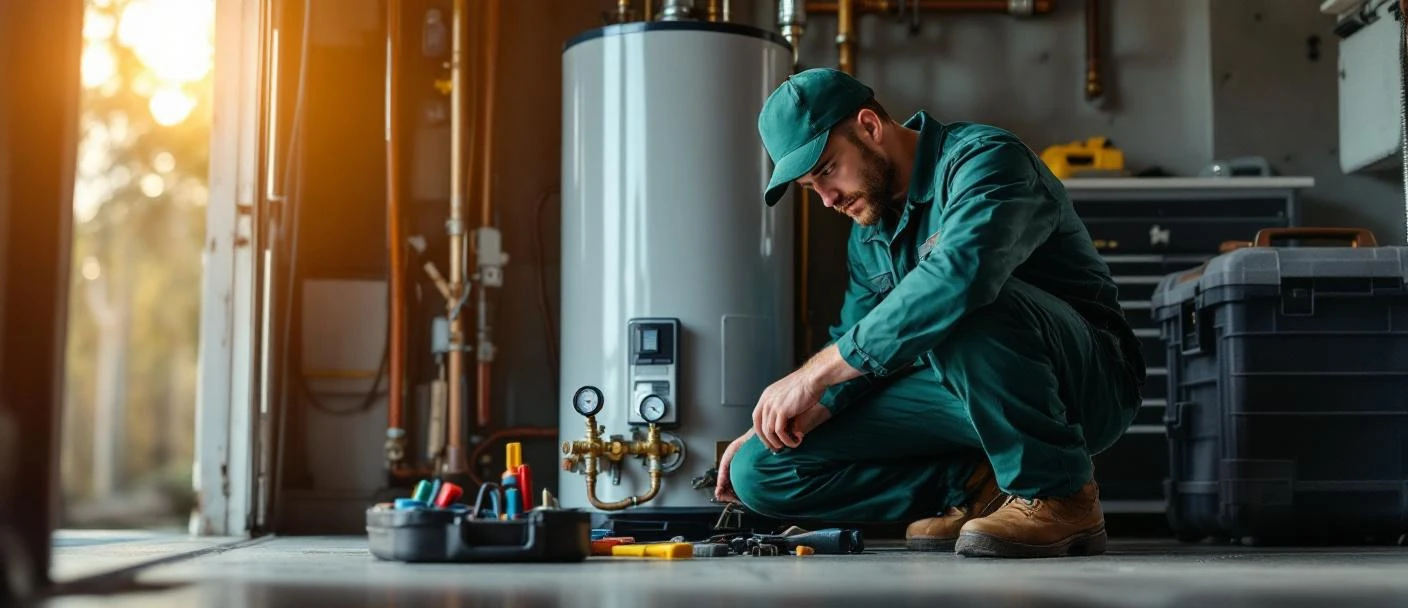
Water Heater Repair Chattanooga TN — when there’s no hot water, lukewarm-only output, or a puddle around the tank, plumbers in our network respond 24/7 across Chattanooga and Hamilton County. Diagnostic-first approach on every call: gas pressure, element resistance, anode condition, T&P verification, then a written estimate before any parts get swapped. Tank, tankless, hybrid heat pump, recirculation systems — Rheem, AO Smith, Bradford White, Navien, Rinnai, Noritz.
A water heater is the single most-used appliance in your home — it cycles 4 to 8 times a day on average. When it fails, the symptoms range from inconvenient (lukewarm shower) to dangerous (T&P valve dumping at 210°F or gas combustion issues). The diagnostic order matters because chasing the wrong symptom costs you parts and time. Our plumbers run the same systematic diagnostic sequence on every call regardless of brand.
Symptoms That Tell You the Tank Is Failing
A failing tank shows up in patterns. No hot water at all with a gas unit usually points at the pilot, thermocouple, or gas valve. The same symptom on electric points at a tripped breaker, blown high-limit ECO (energy cut-off), or both elements out simultaneously. Lukewarm only usually means the lower element on electric or a dip-tube failure on gas — cold water mixes at the top instead of entering the bottom of the tank.
A popping or rumbling sound during heating is sediment in the tank floor — water trapped under the sediment flashes to steam in pockets, creating the noise. Discolored hot water (rusty, sulfur-smelling) points at anode rod depletion. The anode is supposed to corrode in place of the tank wall; when it’s fully consumed, the tank wall starts corroding, and rust enters the hot supply.
Warning Signs to Watch For
- Water at the base of the tank (internal rupture — replacement only)
- Visible rust or scale around the T&P valve discharge
- Persistent sulfur smell in hot water (anode bacteria)
- Discolored hot water that clears when you let it run
- Popping or rumbling during heating cycles
- Pilot won't stay lit after relighting
- Tank exterior shows visible corrosion or insulation bulges
- Tankless unit displaying consistent error codes
Water on the floor near the tank may not be the heater itself — sometimes burst pipe repair on the supply line is the real fix.
What Repair Costs Look Like in Chattanooga
The cost spread on water heater repair is wider than most plumbing services because the diagnostic outcome determines scope. A thermocouple replacement is a 60-minute, sub-$300 job. A tankless heat exchanger replacement is a 4-hour, $1,500+ job. The diagnostic itself is included in the service call fee, so you don’t pay extra to find out which scope applies.
Soft Tennessee River water extends water heater life
Tennessee American Water’s 60-90 mg/L hardness is on the soft side. That means anode rods last 4-6 years on average vs. 2-4 years in hard-water markets, and tank-style heaters typically last 10-15 years in Chattanooga vs. 8-12 in cities like Cincinnati. Soft water is gentler on the tank but more aggressive on copper supply lines.
Diagnostic Walkthrough Our Plumbers Run on Arrival
- 1
Visual Inspection
Tank exterior, T&P discharge, drain valve, supply connections, vent flue, gas connection or electric panel.
- 2
Power/Gas Verification
Confirm 240V/30A circuit on electric, or 7" WC inlet pressure on gas.
- 3
Component Test
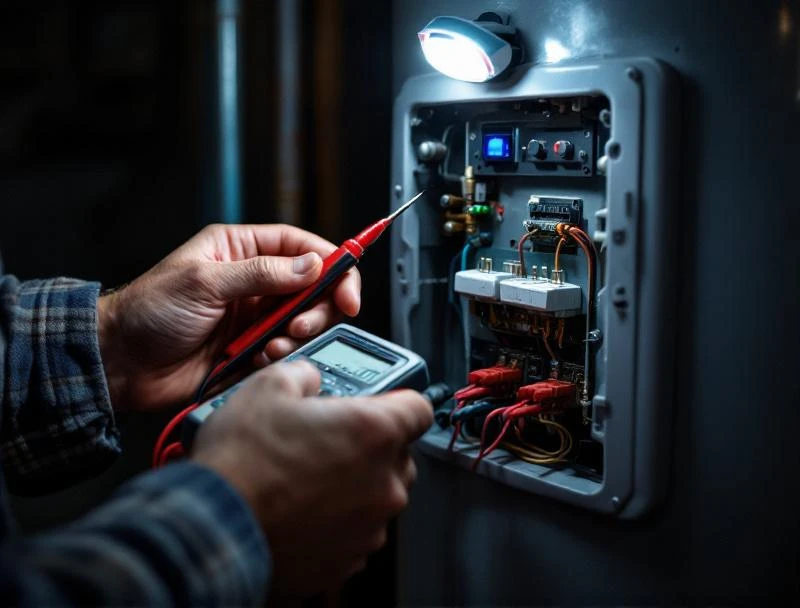
Thermocouple millivolt, element resistance, thermostat continuity, T&P valve operation.
- 4
Tank Condition Check
Anode rod inspection, sediment depth, dip tube continuity test.
- 5
Written Estimate
Repair vs. replace recommendation with line-itemed pricing before any work.
- 1
Visual Inspection
Tank exterior, T&P discharge, drain valve, supply connections, vent flue, gas connection or electric panel.
- 2
Power/Gas Verification
Confirm 240V/30A circuit on electric, or 7" WC inlet pressure on gas.
- 3
Component Test
Thermocouple millivolt, element resistance, thermostat continuity, T&P valve operation.
- 4
Tank Condition Check
Anode rod inspection, sediment depth, dip tube continuity test.
- 5
Written Estimate
Repair vs. replace recommendation with line-itemed pricing before any work.
The diagnostic order isn’t arbitrary — it follows the failure-rate distribution. In gas tanks, thermocouple failure is the most common no-hot-water cause (about 40% of calls), so we test it second after confirming gas supply. In electric tanks, lower-element failure dominates (about 35% of calls), so element resistance testing is second after confirming 240V at the terminals.
Tankless Water Heater Service
Tankless units (Navien NPE-A2, Rinnai Sensei RSC, Noritz EZTR40, Takagi TK-310U, Bosch Greentherm) need different diagnostic procedures than tank units. Most tankless service calls trace to one of four causes: scale buildup in the heat exchanger, gas pressure inadequate for full BTU load, vent obstruction, or flow sensor fouling. The diagnostic sequence runs through them in that order.
Descaling is preventive maintenance that’s often skipped. Tankless heat exchangers in Chattanooga’s 60-90 mg/L water need descaling every 18-24 months even though the water is relatively soft. The procedure: isolate the unit at the service valves, circulate vinegar or commercial descaler with a pump for 45 minutes, flush with clean water, restore.
Gas pressure inadequacy is the dominant Navien-NPE-A2 fault in older 37402 historic homes. Most pre-2010 Chattanooga homes have 1/2” gas line which delivers enough BTU for a 40-gallon tank but not enough for a 199,000 BTU/hr tankless. The fix is gas line upsize to 3/4” or 1” — see our gas line repair page for the full scope.
Power Vent Diagnostic
Power-vent gas water heaters (induced-draft fan, sealed combustion) are common in tightly-built post-2000 37421 East Brainerd homes where atmospheric venting isn’t viable. The fan, pressure switch, and vent obstructions are the three primary failure points.
The pressure switch tests as a simple yes/no: with the fan running, the switch should close. If the switch shows open at the manifold, either the switch is bad, the hose to the switch is plugged, or the vent has back-pressure from obstruction. Combustion-air pathway verification follows.
Anode Rod Replacement
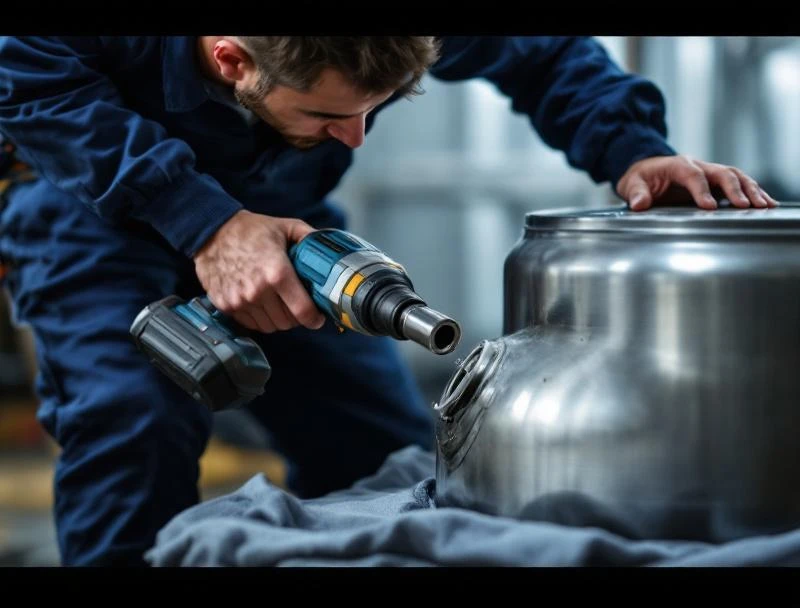
The sacrificial anode rod is the cheapest insurance against tank failure. Magnesium and aluminum rods come in screw-in (3/4” hex) or recessed-hex configurations; powered anodes are an upgrade for sulfur-bacteria-prone wells in 37363 Ooltewah. Removal requires a 1-1/16” socket on a cordless impact driver — the rod is torqued into the tank head and almost always seized after 5-7 years.
In Chattanooga’s water, magnesium anodes typically deplete to 90% consumption in 4-6 years. We replace at the 80% threshold to preserve continued protection. Powered anodes (Corro-Protec) eliminate the periodic replacement cycle and solve sulfur-smell problems where standard anodes feed the bacteria.
Thermocouple Replacement
The thermocouple is the safety device that proves the pilot is lit before the gas valve opens for the main burner. When it fails, the gas valve assumes “no flame” and shuts off the gas — pilot won’t stay lit. Replacement is a 30-60 minute job: shut off gas, remove burner assembly, swap thermocouple (universal kits cover most lengths: 18”, 24”, 30”), reinstall, relight pilot.
Most failures show up as: pilot lights normally but goes out when you release the button. Less common: pilot won’t light at all (thermopile fault on millivolt-style controls). Universal thermocouple kits cost $15-30 in parts; the labor and travel charge is what makes the call $185-285.
Heating Element Replacement
Electric water heaters use 4500W/240V elements rated for residential service. Lower-element failure is common because sediment surrounds the lower element first; upper-element failure is rare unless the unit has been running dry. Resistance testing with a multimeter discriminates: a good 4500W element shows 10-16 ohms across the terminals; an open element shows infinite resistance.
Replacement requires draining the tank below the element (about 8 gallons for a 50-gal unit), removing the element with a 1-1/2” socket, installing the new element with a fresh gasket, refilling, restoring power. Total time 1-2 hours for a single element.
T&P Valve Replacement
The temperature-and-pressure relief valve is required by Tennessee Plumbing Code §504.6. It opens at 150 PSI or 210°F, whichever comes first. Brand options include Watts 100XL and Cash Acme FVMX. The discharge tube must terminate within 6” of the floor and use full-size piping (no reduction).
A T&P that’s dripping is usually responding correctly to thermal expansion in a closed system. The fix is adding an expansion tank, not replacing the valve. A T&P that won’t reset after a manual test pull needs replacement — once the valve has lifted, the seat may not re-seal cleanly.
The discharge from a T&P valve shall terminate atmospherically not less than 6 inches and not more than 24 inches above the floor, by gravity, with no shut-off valves and no reductions in pipe size. The discharge tube must be the same size as the valve outlet (typically 3/4”).
Expansion Tank Installation
Tennessee Plumbing Code requires a thermal expansion tank when a check valve, backflow preventer, or PRV creates a closed-loop system on the supply side. The expansion tank absorbs the thermal expansion that occurs as cold water in the tank heats and expands by about 2% in volume. Without an expansion tank, that expansion lifts the T&P or stresses fittings.
Common brands: Watts DET-5 and ST-5, Amtrol Therm-X-Trol ST-5 and ST-12. Pre-charge pressure default is 40 PSI; field-adjust to match your home’s static pressure. Installation point is on the cold supply line near the heater inlet, oriented vertically with the diaphragm facing up.
Sediment Flushing
Even Chattanooga’s softer water deposits sediment over years. The popping/rumbling sound comes from water flashing to steam under sediment layers. Annual flushing extends tank life and recovers heating efficiency. Procedure: shut off gas/power, attach garden hose to drain valve, route to floor drain or outside, open drain valve, run until flow is clear (typically 5-10 minutes for a tank that’s been flushed before, longer for a 5-year-no-flush situation).
For severely sedimented tanks where the drain valve is plastic and breaks at first attempt, we install a brass replacement drain valve as part of the flush scope. The brass valve seats reliably and survives future flushes.
Recirculation Pump Issues
Hot-water recirculation pumps (Grundfos Comfort, Taco 006) move hot water continuously or on-demand through a return line, eliminating the wait at distant fixtures. Common failures: aquastat thermostat stuck open or closed, motor seized from sediment, return-line crossover valve failure on demand-style systems.
37421 East Brainerd and 37363 Ooltewah newer construction commonly has dedicated recirculation return lines, while older 37405 historic homes typically use crossover-valve recirculation under sinks. The crossover-valve style is more failure-prone — small valves with rubber diaphragms in a hot-water environment.
Hybrid Heat Pump Water Heater Service
Heat pump water heaters (Rheem ProTerra, AO Smith Voltex, Bradford White AeroTherm) extract heat from the surrounding air and transfer it to the tank via refrigerant. They use about 60% less energy than standard electric and qualify for TVA and EPB rebates in Chattanooga, which has driven adoption since 2022.
Common service items: refrigerant compressor short-cycling (usually low refrigerant or fan obstruction), evaporator coil ice-up (humidity sensor failure), and standard electric-element backup failure (the auxiliary elements run during high demand). The refrigerant side is more service-intensive than the electric side and requires manufacturer-trained technicians for warranty work.
No hot water this morning?
Most diagnostic visits finish in under 90 minutes. Call now for same-day service across Chattanooga and Hamilton County.
Brand-Specific Failure Patterns: Rheem, AO Smith, Bradford White
Water Heater Brands We Service
Common Tankless Error Codes
Common Error Codes
| Brand | Code | What It Means |
|---|---|---|
| Rheem | 11 | Ignition failure — no flame after 3 attempts |
| Rheem | 12 | Flame loss mid-cycle |
| Rheem | 14 | Thermal fuse open (overheat) |
| Rheem | 16 | Outlet temperature exceeded limit |
| Bradford White | E20 | Gas valve fault |
| Bradford White | E40 | Sensor fault |
| Bradford White | E60 | Flame loss |
| AO Smith | 11 | Ignition failure |
| AO Smith | 33 | High temperature limit |
| AO Smith | 51 | Vent obstruction |
| AO Smith | 61 | Fan failure |
| Navien | 003 | Ignition failure (often gas pressure) |
| Navien | 010 | Fan motor fault |
| Navien | 027 | Abnormal flame signal |
| Navien | 113 | Condensate drain clogged |
| Rinnai | 11 | Ignition failure |
| Rinnai | 12 | Flame loss |
| Rinnai | 25 | Condensate drain blocked |
| Rinnai | 32 | Thermistor fault |
| Noritz | 11 | No ignition |
| Noritz | 14 | High temperature limit |
| Noritz | 90 | Combustion abnormal |
How Tennessee River Water Affects Anode Rod Lifespan
Tennessee American Water’s softer water profile means magnesium anode rods last 4-6 years on average vs. 2-4 in harder-water cities. That’s good lifecycle math. The catch: when a rod finally depletes, owners often delay replacement and the tank wall starts corroding from the inside. By the time external symptoms appear (rust in hot water, T&P weeping), the tank is usually past saving.
The preventive maintenance window: replace the anode at year 5-6 even if there are no symptoms. The replacement cost is $285-$485 ; the avoided cost is the $1,650-$2,650 of a full tank replacement. The math favors prevention by 5x to 9x.
Chattanooga Gas Company supplies natural gas at 7” water column inlet pressure standard. Most pre-2010 homes have 1/2” gas line which delivers enough BTU for a 40-gallon tank but undersized for 199,000 BTU/hr tankless units. Tank-to-tankless conversions in 37402 historic homes almost always require a gas line upsize to 3/4” or 1” — see our gas line repair page for the full scope.
If the bill is climbing without obvious cause, a high-water-bill diagnosis can isolate whether it’s the tank or another fixture.
Tennessee Code Requirements for Replacement Installs
Tennessee Plumbing Code §504 governs water heater installation. Critical requirements include:
- T&P valve discharge to floor with 3/4” piping, no reduction (§504.6)
- Drip pan with separate drain piping for heaters in attics or above finished spaces (§504.7)
- Vacuum relief valve when cold supply is below the heater inlet (§505.4)
- Sediment trap (drip leg) on the gas inlet (Tennessee Mechanical Code)
- 240V/30A dedicated circuit for electric units
- Direct-vent (Category IV) tankless allowed in any room with sealed combustion
A water heater installed in a location where leakage will damage the building structure shall be installed in a galvanized steel pan or other approved pan, with a separate drain line piped to the exterior or to an indirect waste receptor. Common requirement in 37377 Signal Mountain attics and second-floor utility closets.
Most tank-to-tankless conversions in 37343 require a tankless water heater gas-line upsize before code sign-off.
For seasonal homes on Lookout Mountain, vacant-home winterization protects the heater alongside the rest of the plumbing.
When a Repair Saves You and When Replacement Pays Off
| Situation | Repair Wins | Replacement Wins |
|---|---|---|
| Tank under 6 years old, single-component failure | Yes — repair | — |
| Tank 6-10 years, anode depleted, no leak yet | Yes — anode + element | — |
| Tank 10-15 years, water-quality issues | Marginal | Often makes sense |
| Tank over 15 years, any failure | — | Yes — replace |
| Visible water at base of tank | — | Yes — internal rupture |
| Tankless under 8 years, error code only | Yes — repair | — |
| Tankless heat exchanger crack | — | Yes — replace |
| Recurring sediment-induced popping (5+ year tank) | Flush + element check | Replace if recurring |
| Want to upgrade to tankless or hybrid | — | Yes — replace with conversion |
Why a Cold-Water Morning in 37405 Often Means a Failing Element
37405 North Chattanooga and Riverview have a high concentration of electric water heaters in 1950s-1970s homes. Lower-element failure is the dominant call type from this ZIP. The diagnostic is fast: shut off power at the breaker, remove access panels, test resistance at the lower element terminals. 10-16 ohms = good. Infinite = open element, replace.
The repair is also fast: drain to below the element, remove with element wrench, install new element with fresh gasket, refill, restore power. Total scope is usually 1-2 hours including drain and fill time. Cost falls in the $235-$385 range.
Service Cost Calculator
Quick Estimate
Estimates are approximate. Call for written quote.
What Every Service Call Includes
What Every Service Call Includes
- Written estimate before any work begins
- Upfront pricing with no hidden fees
- Bonded and insured plumbers in our network
- Background-checked plumbers dispatched to your home
- Same-day emergency response across Hamilton County
- Workmanship stands behind the repair
Before & After: Failed Water Heater to Code-Compliant Install
Failed unit, undersized scope
- Tank wall corroded through (rust in hot water)
- No expansion tank on closed-loop supply
- T&P discharge undersized to 1/2" copper
- No sediment trap on gas inlet
- No drip pan in attic location
- Original anode at 100% depletion
Code-compliant replacement
- New 50-gal AO Smith Signature gas tank
- Watts DET-5 expansion tank installed
- 3/4" T&P discharge to floor with air gap
- Sediment trap added at gas inlet
- Galvanized drip pan with drain to exterior
- First anode replacement scheduled at year 5
Service Stats
For tank failures that surface in the middle of the night, our 24/7 emergency plumber service dispatches a technician the same hour.
What This Service Costs in Chattanooga
| Service | Chattanooga Range | Time Required |
|---|---|---|
| Thermocouple replacement, gas tank (37411 Brainerd) | $185 – $285 | 1 – 2 hours |
| Lower heating element replacement (37343 Hixson) | $235 – $385 | 1 – 2 hours |
| Anode rod replacement, recessed-hex | $285 – $485 | 1 – 3 hours |
| T&P valve replacement with discharge re-routing | $235 – $345 | 1 – 2 hours |
| Expansion tank installation | $285 – $465 | 1 – 2 hours |
| Tank flush + diagnostic (37416) | $185 – $285 | 1 – 2 hours |
| Tankless descale service (Navien NPE-A2) | $285 – $485 | 2 – 3 hours |
| Power-vent fan replacement (Bradford White) | $485 – $785 | 2 – 4 hours |
| Recirc pump replacement (Grundfos Comfort) | $385 – $585 | 2 – 3 hours |
| Tankless flow-sensor replacement | $385 – $685 | 2 – 3 hours |
| 50-gal gas tank like-for-like replacement | $1,650 – $2,650 | 3 – 5 hours |
| 50-gal-to-tankless conversion (37343) | $3,850 – $6,500 | 1 – 2 days |