
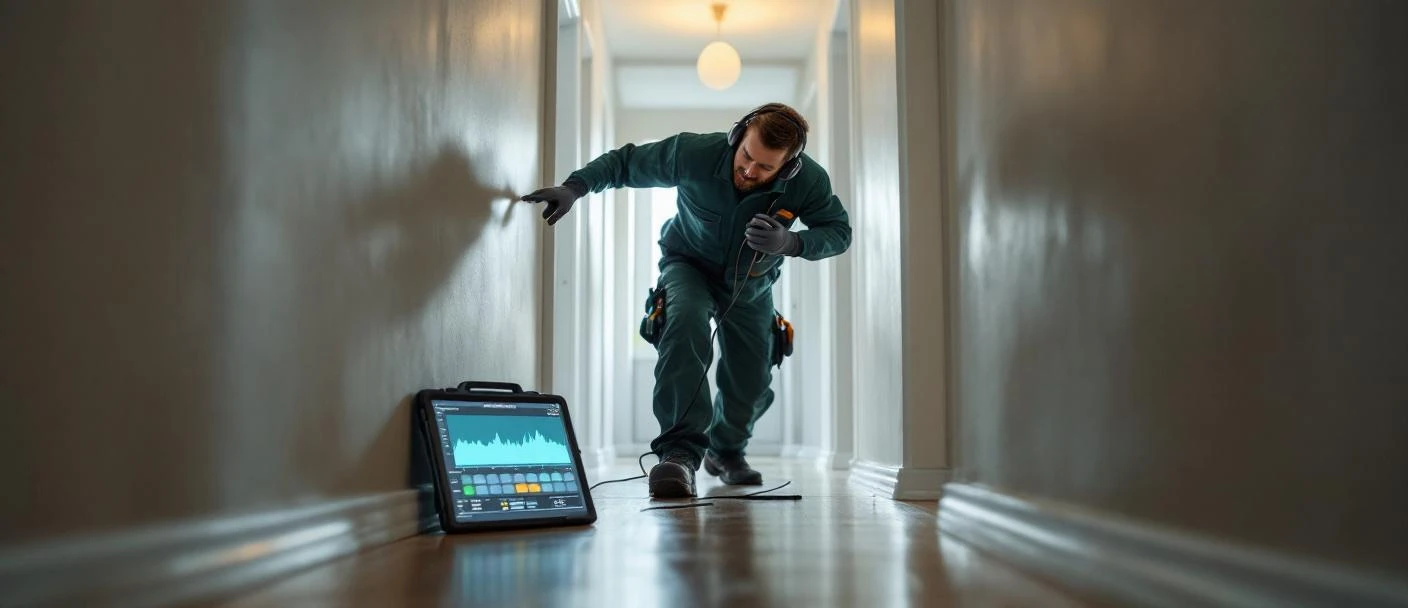
Leak Detection Chattanooga TN — when your bill spiked but you can’t see water anywhere, plumbers in our network arrive with acoustic ground microphones, FLIR thermal cameras, Tramex moisture meters, borescopes, and helium tracer gas to find the leak before drywall has to come down. Walls, ceilings, attics, irrigation, supply lines, and high-water-bill diagnostics. Pinpoint accuracy to within inches of the leak source.
A hidden leak is the most economically dangerous plumbing problem because it’s slow. The water doesn’t show up at the surface for weeks — sometimes months — while the cost compounds. Bill increases, drywall saturation, mold colonization, framing decay. Catching it in week one costs you a few hundred dollars in detection plus the repair. Catching it in month three costs you thousands in remediation.
What Hidden-Leak Detection Costs in Chattanooga
Water-meter test plus walk-down runs $185-$285 . Acoustic detection in a focused area runs $385-$585 . Full-house thermal scan runs $385-$685 . Multi-method detection runs $485-$985 . Pinpoint with access cut runs $485-$885 . Detection-only insurance documentation runs $285-$485 .
High Water Bill, Stains, and Sounds That Reveal Hidden Leaks
Warning Signs to Watch For
- Water bill 20%+ higher than baseline with no explanation
- Faint sound of running water when no fixtures are on
- Persistent damp smell with no visible source
- Stained ceiling tile or drywall with no obvious water source above
- Discolored drywall paper or paint at base of wall
- Wood floor cupping or warping in concentrated area
- Mold growth on wall or ceiling without humidity cause
- Tennessee American Water meter triangle moves with all fixtures off
The water-meter triangle test is the cheapest first-pass diagnostic. Walk to the meter, shut every fixture in the house including ice makers and humidifiers, watch the indicator triangle for 5 minutes. Any rotation indicates flow on the system. Tennessee American Water meters in Chattanooga have triangles that rotate with very low-flow leaks — often before visible symptoms appear.
If the leak escalates into spraying water, an active leak emergency in 37405 supersedes scheduled detection work.
The Diagnostic Sequence Our Plumbers Run on Arrival
- 1
Water Meter Test
All-fixtures-off observation confirms whether a leak exists at all.
- 2
Hot vs Cold Isolation
Shut water heater outlet — if triangle stops, leak is hot-side; continues, cold-side or both.
- 3
Acoustic Walk-Down
Ground microphone room-by-room to localize leak sound signature.
- 4
Thermal Sweep
FLIR camera identifies thermal anomalies in walls, ceilings, floors.
- 5
Pinpoint & Mark
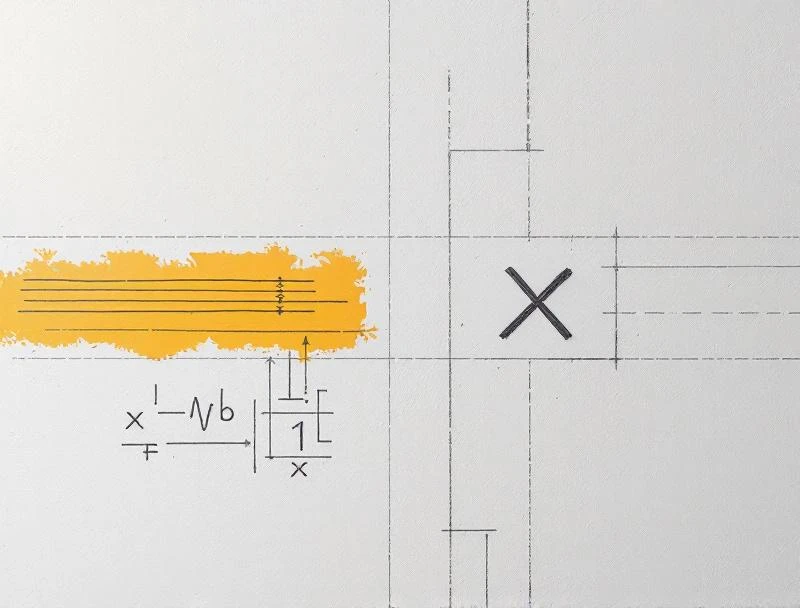
Marker paint X with depth note. Repair scope follows.
- 1
Water Meter Test
All-fixtures-off observation confirms whether a leak exists at all.
- 2
Hot vs Cold Isolation
Shut water heater outlet — if triangle stops, leak is hot-side; continues, cold-side or both.
- 3
Acoustic Walk-Down
Ground microphone room-by-room to localize leak sound signature.
- 4
Thermal Sweep
FLIR camera identifies thermal anomalies in walls, ceilings, floors.
- 5
Pinpoint & Mark
Marker paint X with depth note. Repair scope follows.
Often a hidden leak is just a failed wax seal — toilet repair handles that scope without further detection cost.
Acoustic, Thermal, Moisture-Mapping, and Dye-Test Methods Compared
Acoustic listening (Fluke ALD-2, SubSurface LD-12, Goldak Tritector, SewerIn AquaPhon A200) detects high-frequency leak hiss through drywall, plaster, tile, and concrete. Best at pinpointing pressurized supply leaks. Less effective on slow-drip drain leaks (no pressure to generate audible signal).
Thermal imaging (FLIR E8-XT, E96, T540, C5) detects temperature anomalies. Hot-water leaks show as warm spots; cold-water leaks show as cool spots from evaporative cooling. Best at large-area scanning to localize the search area before acoustic pinpointing.
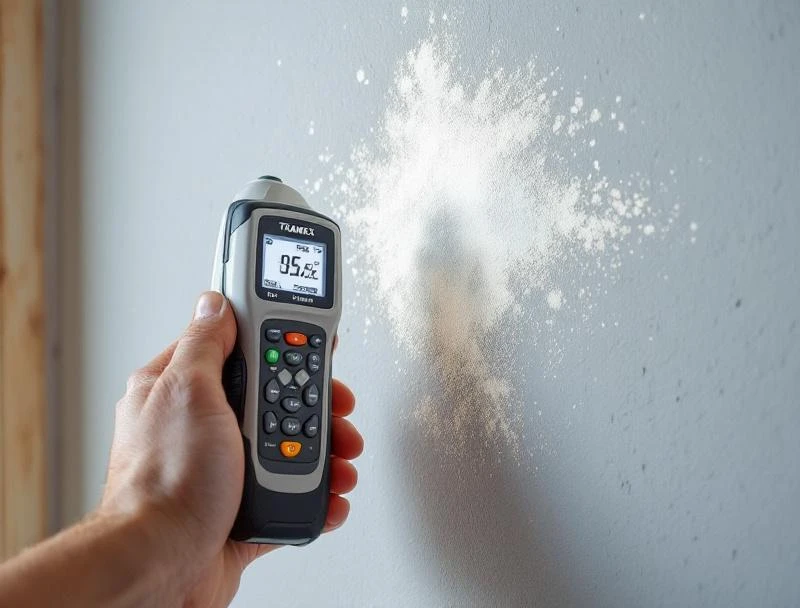
Moisture meters (Tramex CME-4 pinless, MEP, Delmhorst BD-2100 pin-style) measure substrate moisture content. Pinless meters scan large areas without damage; pin meters confirm depth penetration. Used to confirm suspected wet area and map extent of saturation.
Dye testing (fluorescein concentrate, toilet leak dye tablets) traces drain-side leaks. Add dye to suspect drain (toilet tank, tub overflow, shower drain), wait, walk-down with UV blacklight to find the path. Effective for confirming wax-ring leaks vs. wall-cavity supply leaks.
Acoustic Leak Detection
The ground microphone is the workhorse. Frequency filtering on the LD-12 isolates leak signal from low-frequency rumble (HVAC, refrigerator). Best results during quiet morning hours before HVAC peak. Trained listening discriminates leak hiss from ambient pipe flow.
Plaster walls in pre-1940 37402 and 37405 housing transmit acoustic signal differently than drywall — the same detector requires frequency-filter adjustment. Galvanized supply lines (legacy 37411 ranches) show a different acoustic leak signature (rumble) vs. copper (hiss) vs. PEX (muted) — experienced technicians read these differences.
Infrared / Thermal Imaging
The FLIR camera shows surface temperature in real time. Hot-water leaks reveal as a thermal halo; cold-water leaks reveal as evaporative cooling spots. Emissivity adjustment matters — concrete, tile, drywall, and hardwood have different emissivity values affecting apparent temperature.
For ceiling leaks from upstairs bathrooms, thermal imaging during fixture use captures the leak path as the warm water flows. Static imaging often misses small leaks; dynamic imaging during fixture cycling catches them.
Moisture Meter Mapping
Tramex CME-4 pinless meter scans drywall and plaster surfaces non-destructively, reading moisture content to a depth of about 3/4”. The grid-pattern scan maps the wet area extent. Pin-style Delmhorst meters confirm depth penetration where pinless readings are ambiguous.
A typical wet-wall investigation: pinless scan in a 1-foot grid pattern over the suspected area, mark high-reading squares, pin-test depth penetration at the highest readings, plan access cut at the highest-reading point.
Dye Testing
Fluorescein dye is bright green-yellow under normal light, fluorescent under UV blacklight. Drop a tablet in the toilet tank — if dye appears in the bowl without flushing, the flapper or flush valve seat is leaking. Drop dye in a suspected drain — if dye appears at a stain location below, the drain leak is confirmed.
For ceiling leaks below upstairs bathrooms, dye testing each upstairs fixture in sequence (toilet, tub, shower, sink) discriminates which fixture is the source.
Video Inspection of Accessible Lines
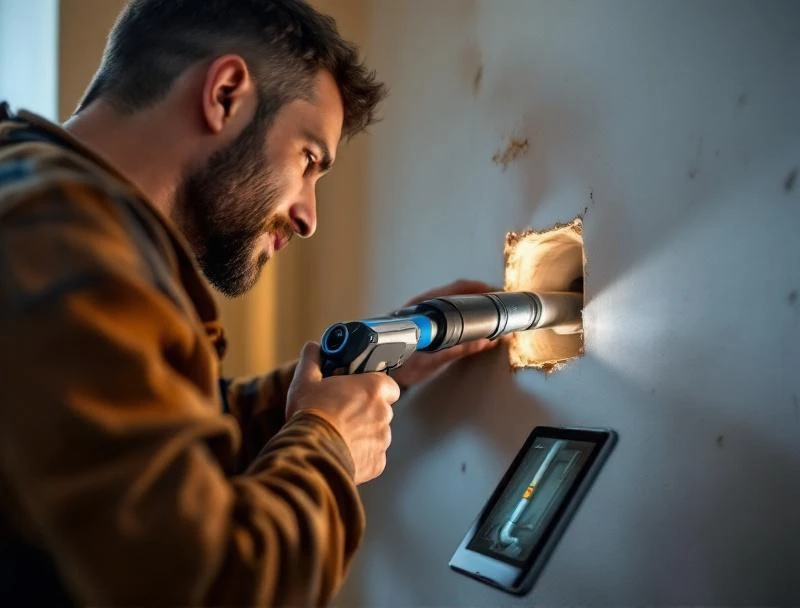
Borescopes (Milwaukee M-Spector, RIDGID micro CA-350, Teslong NTS300) provide visual access through small holes. Articulating tip versions navigate around obstacles. Most useful for confirming suspected leak location before opening the wall — drill a 5/8” hole, snake the borescope through, visualize the pipe and any moisture on the cavity floor.
Water-Meter Isolation Testing
Sequential isolation maps the leak to a system zone. Shut at the water heater outlet to isolate hot-only. Shut at the irrigation control valve to isolate irrigation. Shut at the angle stops on a fixture group to isolate that group. The decay rate at each isolation step tells us which sub-zone has the leak.
For homes with PEX manabloc manifolds (post-2000 37421 East Brainerd), each fixture has its own shut-off at the manifold — drastically faster diagnosis than older home-run copper systems.
Irrigation System Leak Finding
Post-2010 37421 East Brainerd irrigation systems frequently leak undetected because the water disappears into the lawn rather than the home. Zone-by-zone isolation and pressure-decay testing identifies the leaking zone. Common failure points: solenoid valve diaphragm, irrigation backflow preventer, broken sprinkler heads, and underground line breaks from frost heave.
Water bill spiked without explanation?
The water-meter triangle test is free and takes 5 minutes. If the triangle moves, call us.
Pressure Decay Testing
System-wide pressure-decay test confirms leak existence and quantifies severity. Pressurize the system to 80 PSI (typical residential supply), close the main, monitor pressure over time. 1 PSI decay over 5 minutes is typical acceptable seal; faster decay indicates active leak.
Pinhole Leak Location
Copper pinhole pitting from chloramine corrosion is a Chattanooga-specific failure pattern, particularly on 1995-2010 hot-water lines. The acoustic signature is distinctive — high-pitched hiss with modulated amplitude. Once located, repair scope is typically a section replacement (cut back to clean copper, install repair coupling).
The water-meter triangle catches leaks below 0.25 gpm
Tennessee American Water residential meters detect flow as low as 0.25 gpm . A leak below that threshold may not register on the triangle but will still be detectable acoustically. The triangle test gives confirmation of meaningful leaks; quieter leaks need acoustic walk-down to find.
Branch-Line Isolation
Closing angle stops in sequence isolates each branch. The diagnostic: shut the kitchen group, observe meter; shut the master-bath group, observe meter; etc. The branch where shutoff stops the meter movement contains the leak.
PEX manabloc systems make this faster — each fixture has an individual shut-off at the manifold. Older home-run copper requires per-fixture shut-off at the angle stop, which takes longer per cycle.
Wall-Cavity Leak Finding
Wall-cavity leaks reveal three ways: visible drywall stain or bubble, audible leak signature, or moisture-meter reading. The acoustic + moisture combination is fastest. Listen first to localize, then moisture-map the suspect zone, then drill a 5/8” access hole at the highest-reading point for borescope confirmation.
Plaster walls in 37402 historic homes transmit acoustic signal differently than drywall — frequency adjustment on the detector helps. Stain-pattern reading also helps: water typically travels down studs and joists, so the stain location is often below the actual leak point.
Ceiling Leak Source Tracing
Ceiling leaks from upstairs bathrooms are top-3 lead-source intent in our service area. The diagnostic order: dye-test each upstairs fixture (toilet, tub, shower, sink) in sequence, thermal scan during fixture use to catch active flow, distinguish supply-line vs. drain-line via dye spread pattern.
The AC-condensate-vs-plumbing distinction matters here — Chattanooga’s HVAC condensate lines from 1990s 37343 Hixson split-systems frequently masquerade as plumbing leaks. Touch test (ambient cool vs. hot/cold supply temp) is the fastest discriminator.

Why Wall and Ceiling Leaks Hide Differently in 37402 Plaster vs 37421 Drywall
Plaster walls common in pre-1940 37402 and 37405 housing have higher density and thicker substrate than drywall. Acoustic signal propagates differently — leak hiss attenuates faster but pipe-flow vibration travels further. The detector requires frequency-filter adjustment for accurate plaster wall scanning.
Drywall walls common in post-1960 housing transmit higher-frequency leak signal more clearly but also pick up more ambient noise. Quiet-period scanning (early morning, HVAC off) gives best results in drywall homes.
For 37421 East Brainerd post-2000 construction with PEX manabloc systems, fixture-by-fixture manabloc shut-off is the fastest diagnostic — close manifold valves in sequence, observe water meter, identify the failing fixture.
Below-grade leaks under concrete are handled separately under slab leak detection — different equipment and methodology.
Tennessee Code Implications for Repair Scope After Detection
Concealed water piping shall be tested at 1.5x working pressure or 50 PSI minimum, whichever is greater. Relevant when post-detection repair triggers permit. Most home-side residential repairs don’t require permit unless the scope exceeds dollar thresholds or involves a fixture-count change.
If detection points to a buried drain leak, sewer line repair takes over the scope from above-grade detection.
When the Water Meter Test Tells You Everything You Need
The triangle test is so reliable that it eliminates the need for further diagnostic when the result is negative. If the triangle doesn’t move with all fixtures off, you don’t have an active supply-side leak. The bill spike has a different cause: drain-side leak (which doesn’t affect the meter), increased usage you forgot, or a one-time toilet-running event.
The triangle test only catches active leaks at the time of testing. Intermittent leaks (only flow during fixture use) won’t show. For those, dye testing each fixture in sequence is the diagnostic.
Why a Sudden Spike in Your Bill Means Faster Action Saves Walls
A water bill spike means flow has been happening for at least the billing period (typically 30 days). By the time the bill arrives, the leak has been active for a month. Saturated framing within 7-14 days, mold colonization within 24-48 hours of saturation, drywall damage progressive after that.
Detection within the first week of the spike: $485-$985 detection plus $485-$1,650 repair. Detection at month three: $485-$985 detection plus $3,000-$8,000+ for water damage, drywall, and mold remediation. The cost difference is meaningful.
Plaster walls require different acoustic technique than drywall
Plaster walls common in pre-1940 37402 and 37405 housing transmit acoustic leak signal differently than drywall. The detector requires frequency-filter adjustment for accurate plaster scanning. Galvanized supply lines (legacy 37411 ranches) exhibit a different acoustic leak signature (rumble) vs. copper (hiss) vs. PEX (muted) — experienced technicians read these differences.
Brands We Use
Detection Equipment
Comparison: Detection Method by Leak Type
| Leak Type | Best Method | Backup Method |
|---|---|---|
| Pressurized supply pinhole in wall | Acoustic ground mic | Thermal during use |
| Slow drain leak in wall | Dye test + moisture meter | Borescope through hole |
| Ceiling leak from upstairs bath | Dye test each fixture | Thermal during use |
| Toilet wax-ring leak | Dye test | Visual base inspection |
| Hot-water-loop leak | Acoustic + thermal | Pressure decay isolation |
| Cold-water leak in concealed run | Acoustic | Pressure decay isolation |
| Irrigation system leak | Zone isolation + pressure | Visual after zone test |
| AC condensate (mistaken) | Touch test temperature | Source path inspection |
Tennessee American Water meters in Chattanooga have a leak-indicator triangle that rotates with very low-flow leaks — the cheapest first-pass diagnostic. Plaster walls common in pre-1940 37402 and 37405 housing transmit acoustic leak signal differently than drywall. Post-2000 37421 East Brainerd construction with PEX manabloc manifolds allows fixture-by-fixture isolation — faster than older home-run copper. Tile-shower failures in 37411 1960s ranches typically appear at the shower-pan-to-drain interface.
Service Cost Calculator
Quick Estimate
Estimates are approximate. Call for written quote.
What Every Service Call Includes
What Every Service Call Includes
- Written estimate before any work begins
- Upfront pricing with no hidden fees
- Bonded and insured plumbers in our network
- Background-checked plumbers dispatched to your home
- Same-day emergency response across Hamilton County
- Workmanship stands behind the repair
Stats
When a slow hidden leak suddenly opens up, our emergency plumber service can transition from detection straight into stop-the-flow repair.
What This Service Costs in Chattanooga
| Service | Chattanooga Range | Time Required |
|---|---|---|
| Water-meter test + walk-down (37411) | $185 – $285 | 30 – 90 min |
| Acoustic detection only, single area | $385 – $585 | 1 – 2 hours |
| Thermal imaging full-house scan (37421) | $385 – $685 | 1 – 3 hours |
| Moisture mapping with detection report | $285 – $485 | 1 – 2 hours |
| Borescope inspection (single wall area) | $285 – $385 | 1 – 2 hours |
| Dye test with toilet diagnostic (multi-toilet) | $185 – $385 | 1 – 2 hours |
| Irrigation system leak isolation (37363) | $385 – $685 | 2 – 3 hours |
| Pinhole leak pinpoint + access cut (37411) | $485 – $885 | 2 – 4 hours |
| Ceiling leak source trace (upstairs bath) | $385 – $685 | 1 – 3 hours |
| Pressure decay test full-house | $285 – $485 | 1 – 2 hours |
| Refrigerator / ice-maker line leak finding | $185 – $345 | 1 – 2 hours |
| Detection-only insurance documentation report | $285 – $485 | 1 – 2 hours |